Showing posts with label francis ford coppola. Show all posts

Thursday, 26 April 2012

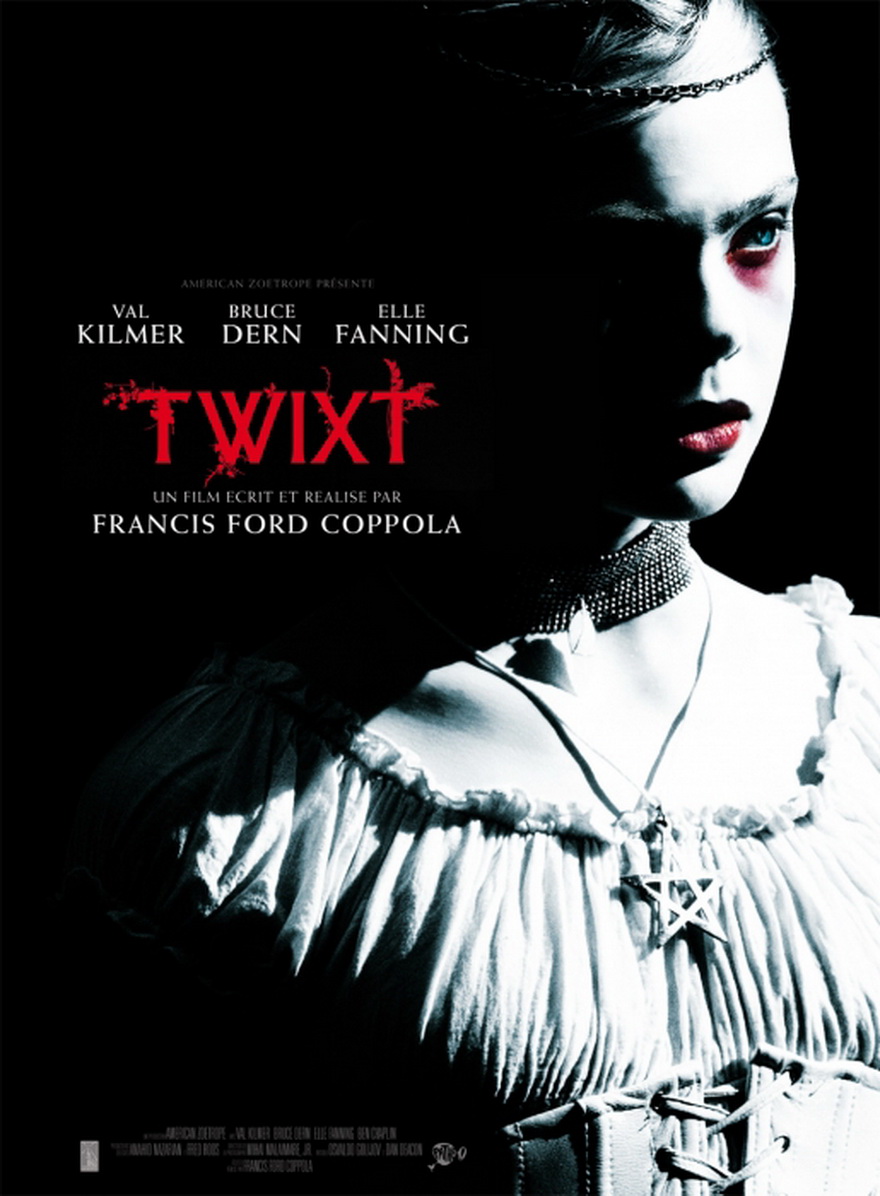
Twixt, Francis Ford Coppola


ENGLISH VERSION COMES AFTER THE FRENCH ONE
Face à la page blanche lumineuse de mon macbook blanc je repense à Hall Baltimore (Val Kilmer) devant le sien avec sa bouteille de whisky et dont l'écriture se délite en même temps que le niveau de sa bouteille descend. Cette scène m'a fait penser à la fausse pub des nuls « bruckler »(ce qui m'a beaucoup fait rire).
Vous vous doutez bien que si j'écris sur Twixt c'est parce que j'ai adoré. Pour moi ce film est une exploration de la créativité.(twixt est en fait une sorte version argotique de between: entre)
Pour moi le pitch de Twixt est: une histoire extraordinaire est offerte, presque sur un plateau à un écrivain médiocre, sa psyché la traite avec brio, mais son rendu sur le papier (objectivé pour nous sur l'écran) sera grand guignolesque.
Toute l'histoire de Twixt est celle de la création et de sa difficulté première: traduire une sensation d'histoire (constellation d'idées, d'ébauches, inspiration non encore clarifiée en langage), convertir une vision mutlisensuelle, multiémotionnelle et sous-jacente en un courant linéaire de mots entrant dans un format littéraire.
Hall Baltimore, Stephen King de solderie, vient promouvoir son dernier livre dans une vallée oubliée de l'Amérique. La seule personne à lui demander un autographe est le vieux Shérif Bobby La Grange, qui veut l'intéresser au meurtre par pieu d'une jeune adolescente. Le vieil homme veut écrire le livre avec Hall. La petite ville a ses mystères : un massacre dans les années 50, Un Beffroi à 7 horloges donnant toutes une heure différente, et eut comme invité de marque Edgar Allan Poe. Bientôt pour Hall le rêve se mêle à la réalité, et une jeune fille, Virginia, 12 ans en faisant 13 vient le hanter, Poe devient son totem, il le guide dans l'histoire de l'assassinat, les méthodes d'écriture et l'ouverture de sa propre psyché.
L'esthétique du film est très travaillée, les rêves sont en noir et blanc façon nuit américaine, avec des éclats de rouges par moment, avec lune, étoiles et forêt de conte de fée. Cette nuit fait écho à celle d'un des films les plus beau du monde: La Nuit du Chasseur, qui partage avec Twixt cette ambiance magique, le thème de la protection et de l'assassinat des enfants et celui du fou religieux qui voit la sexualité, le mal partout.
Twixt est donc résolument post moderne, et en voyant la petite Elle Fanning qui dit qu'elle a douze ans mais en fait treize je pense aussi à Lolita (plus cette fois au roman de Nabokov qu'à l'adaptation de Kubrick, car elle n'est pas ici provocatrice mais victime). 
Le côté malsain que porte aussi Edgar Poe dans cet amour de la mélancolie et celui  très décadent romantique de la petite fille Virginia (qui fût sa muse) est contrebalancé par l'amour paternel et absolument pas ambiguë de Hall Baltimore qui a perdu sa fille du même âge et se rend à peine compte que c'est en fait sur elle qu'il veut écrire, et que c'est d'elle dont il rêve. 
Les vampires sont  une critique de l'effet de mode, l'opportunité pour le shérif et l'éditeur de gagner or et célébrité, ils sont aussi l'excuse pour ne pas regarder les choses en face: le monde dans toute sa bêtise perverse, sa peur de la sexualité.

Ce qui me passionne dans Twixt c'est que non seulement ce film raconte une histoire extrêmement émouvante mais qu'il s'explore en même temps, proposant mille entrées et n'essayant pas malgré tout de séduire le spectateur. Je pense que toute personne qui créer doit le voir, c'est un film magnifique!
                   
In front of the luminous white page of my white macbook, I am thinking of Hall Baltimore ( Val Kilmer) in front of his, with his bottle of whisky and his style which is disintegrating while the level of the liquid in the bottle is subsiding.
You can easily guess that if I am writing about Twixt, it is because I loved it. I haven't read yet any interviews of Francis Ford Coppola about this opus, but in my opinion this film is an exploration of what creativity is.
To me Twixt could be summed up this way: an extraordinary tale is offered to a mediocre writer, his psyche treats it brilliantly, but the result as an opus will be absurdly gory and beside the point.
The outline of Twixt is the path of creation and its inbuilt difficulty of converting a rustling of inspiration, a constellation of vague ideas not yet clarified into language, of translating a multi-sensual, multi-emotional and underlying vision into a straight stream of words, into a literary format.
Hall Baltimore, a « bargain basement » Stephen King, is promoting his latest book in a forgotten American valley. The only person asking him for an autograph is the old sheriff Bobby La Grange, who wants to get Baltimore's attention on the murder of young girl who was found with a stake in her heart. The old man longs to write a novel with Hall. The small city has its mysteries: a mass murder in the fifties, a belfry with seven clocks (none giving the right time), and had as a guest Edgar Allan Poe. Soon for Hall dreams get mixed up with reality, and a young girl, Virginia, twelve looking thirteen comes to haunt him, Poe becomes his totem guiding him through the story of V's murder, writing methods and to opening up to his own psyche.
The aesthetics of this film are very elaborate: the dreams are in black and white, filmed in day for night, with sparkles of red. The Moon, the stars, and the forest are fairytale like. And this magical night echoes the one from one of the most beautiful film ever made: The Night of The Hunter, which shares with Twixt the themes of protecting and murdering children, and of mad religious man who sees evil and sex everywhere.
Twixt is very post-modern, and seeing young Elle Fanning, it's hard not to think of Lolita (Nabokov's not Kubrick's because here she's the real victim). The morbid side also held by the character of Poe ( Ben Chaplin) with his love of melancholic and of the 13 years old Virginia (his muse) is counterbalanced by the fatherly and non ambiguous love of Hall who lost his teenage daughter in a violent accident and is not really aware that it's in fact on her that he wants to write, and that it's about her that he is dreaming.
The fake vampire story is a critic of how society handles youth, it's the opportunity for the sheriff and the publisher to earn gold and celebrity. They are an excuse not to look at thing straightforwardly: the world in its perverse stupidity and its fear of sex.
What fascinates me in Twixt is that this film not only tells a very moving story but in the same time explores its narrative mechanisms, offering a thousand keys, without trying to seduce the viewers. I do think that anyone interested in creation should see Twixt, it's a marvellous film.
                     

Friday, 22 January 2010

TETRO by Francis Ford Coppola


ENGLISH VERSION FOLLOWS

Benny débarque de son paquebot dans un Buenos-Aires d’opérette en noir et blanc. Il va passer quelques jours avec son frère, qui partit il y a onze en congé sabbatique et ne revint jamais. Dans son sac, une lettre d’Angelo dans laquelle il écrivait qu’il viendrait le sauver de leur père tyrannique. Benny s’est échappé de lui-même en s’embarquant sur un paquebot comme un personnage de romans d’aventures. Angelo qui avait fui pour écrire, a tourné le dos à la littérature, à sa famille et à son propre prénom. Désormais il souhaite être nommé Tetro, et Benny n’est pas vraiment bienvenu dans sa nouvelle vie.

Benny trouve le manuscrit de son frère, et décide de le décoder…

Le film raconte l’histoire de Tetro, à travers des flash-backs générés par sa propre narration tirée du manuscrit, des conversations, des colères, un extrait des Contes d’Hoffmann de Powell et Pressburger, la danse (qui transforme les souvenirs en art et pure émotion), et enfin la pièce de Tetro jouée de façon outrée comme du cabaret.

Allant de la pureté totale à une vision opératique, avec des acteurs sobres, et d’autres cabotins, ce film est une symphonie sur l’art et la filiation.


Malgré de nombreuses références au cinéma classique ( par exemple lorsqu’Angelo et son ogre de père marchent sur la plage et passent devant un panneau “No trespassing” comme celui de Citizen Kane d’Orson Welles) et à la littérature ( lorsque Benny travaille chez Aberlardo, il y a derrière lui les portraits d’Hemingway, Antonin Artaud et Rimbaud), ce film ne prend jamais la lourdeur d’une œuvre postmoderne ; et Coppola sait jouer de la trompette du kitsch ( le vulgarissime festival Parricides de Patagonie) en laissant à son récit la pureté d’une tragédie grecque.

Le rôle de Tetro est joué par l’extraordinaire Vincent Gallo, dont le sage perfectionnisme et la minéralité, ne cachent pas les tourments qui se meuvent sous le masque de sa beauté incarnée.

Benny est interprété par le jeune Alden Ehrenreich qui est superbe (rappelant parfois Marlon Brando jeune) à la fois joueur, brillant, curieux et sensible.

Leurs traumatismes, l’amputation d’amour qu’ils ont subit, semble les rendre maladroits, semble les porter à se frotter au danger des routes trop fréquentées et durant tout le film nous sommes suspendu à leur vies qui semblent ne tenir qu’à un fil. Cette fragilité donne le tempo à souffle coupé du film.

Pour moi Tetro a été un choc; j’avais un peu peur dans les 30 premières secondes, de ce noir et blanc plaqué et cette Argentine de cartes postales, mais pratiquement immédiatement j’ai été emportée par la force des émotions des personnages. Le sens de l’humour de cette fresque, son lyrisme, l’excentricité assumée, et l’originalité du traitement m’ont tellement éblouie, que je ne comprends absolument pas que quiconque puisse douter que ce film est un chef d’œuvre ! Il y a si longtemps que je n’avais pas été prise avec une telle force par un film contemporain !

Coppola avec Tetro transcende l’autobiographie en la faisant mythe universel !


PS Attention révélation NE PAS LIRE SI VOUS N'AVEZ PAS VU LE FILM

Le soir où j’ai vu Tetro je me suis couchée à l’intérieur du film, et lorsque le lendemain je me suis réveille, il était toujours présent en moi. La veille j’avais quitté la salle de cinéma encore hantée par les dangers qui avaient été écarté, il m’a fallut un nuit pour me rendre compte que la couleur finale du film est positive car le père monstrueux est sorti du tableau de famille, et c’est l’adulte de référence, le frère qui presque par magie prend le rôle de père pour mener cette famille loin des rivalités et vers l’art.


Benny arrives in an almost dream-like black and white Buenos Aires, to spend a few days with his brother who left the family for a writing sabbatical eleven years ago. In Benny’s bag, there’s a letter that Angelo wrote when he left. He was promising to come back and save him from their tyrannical father. He never did. Benny escaped by himself! Angelo has turned his back on writing, on his family,and even on his own first name. Now he asks to be called Tetro and he does not really welcome his younger brother.

Benny finds his brother’s coded manuscript, and decides to decipher it…

So this film tells Tetro’s story through flashbacks generated by his own narration from the manuscript, extracts of the Powell and Pressburger’s film: The Tales of Hoffmann; ballets (transfiguring the memory into pure art and emotion), and the played cabaret like play from Tetro’s manuscript… Going from deliberately pure to operatic, with sober actors and over the top ones, this film is like a symphony about art and filiations. One by one, it unveils Tetro’s traumas: his mother who was killed in a car accident while he was driving. A genius father who took everything from everybody around, like a fairy tale monster…


Despites the numerous references to classic cinema (like when Angelo and his bigger than life father walks on a beach where a “no trespassing” sign reminds of the one in Orson Welles’s Citizen Kane), and to literature (when Benny works in Aberlardo’s house, there are around him three little portraits: a picture of Hemingway, a drawn self-portrait of Antonin Artaud, and another of Arthur Rimbaud), this film never becomes post-modern. Despites the sometime kitchness of the scenery (the Parricides festival of Patagonia) Coppola keeps it as pure as Greek tragedy.


The part of Tetro is played by the extraordinary Vincent Gallo, whose wise perfectionism and minerality, do not hide the torments that are going on under the mask of his incarnated beauty.

Benny played by Alden Ehrenreich is amazing, playful, brilliant, curious and sensitive.

Their trauma, like their artistic sensitivity, seem to have made Tetro and Benny destined to have dangerous accidents, and we spend the film suspended by the fear they can be crossed over by a car or a cruel destiny. This fragility creates the breathless tempo of this opus.

To me Tetro was a shock; I was a bit scared at the beginning by the flat black and white and fake Argentina, but soon the force of the characters’ emotions. The sense of humour, the assumed eccentricity, the originality of the treatment amazed me so much, that I absolutely don’t understand people who won’t consider it as a master-piece. It’s been so long since such an ambitious and altogether human film has made me feel that way: cinematically fulfilled!

Coppola with Tetro transcends autobiography by making it an universal myth!


PS with ***spoiler alert***:

After I saw Tetro, I went to bed with this film and also woke up with it. Strangely when I left the cinema I was still haunted by the risks taken by the characters and the possibility of all of the story turning into a tragedy, but when I woke up the following morning I thought that without a doubt it was a fairy tale and that the ogre father was out of the family portrait because by magic the surrogate, the brother had taken his role to lead this family far from rivalries and to art.


Bookmark and Share

Related Posts Plugin for WordPress, Blogger...